





Ayurveda is one of the oldest systems of health and wellness in the world. Developed over thousands of years on the Indian subcontinent, it approaches wellbeing not as a set of isolated symptoms to fix but as a state of balance to maintain. Nowhere is this philosophy more evident than in how Ayurveda thinks about hair.
For centuries, specific plants and botanicals have been used across generations to support scalp health, strengthen the hair shaft, and address common concerns like thinning, dryness, and early greying. Many of these ingredients are still in active use today, and modern research is beginning to examine the mechanisms behind their traditional applications.
Here are eight of the most significant.
Why Ayurveda Places Importance on Scalp Health
In Ayurvedic philosophy, the scalp is not simply a surface. It is the foundation from which healthy hair grows. Before addressing the strand, Ayurveda addresses the root, literally and philosophically.
Scalp health in this tradition is closely linked to circulation, balance of the three doshas (Vata, Pitta, and Kapha), and the nourishment of the hair follicle itself. This is why traditional Ayurvedic haircare begins with oiling: the practice of massaging warm, botanically infused oils into the scalp to stimulate circulation, calm inflammation, and feed the follicle from below.
This logic aligns closely with what modern trichology tells us: a healthy, well nourished scalp environment is one of the most important factors in long term hair health.
1. Bhringraj: The King of Hair
Bhringraj, known in scientific literature as Eclipta alba, holds a revered place in Ayurvedic haircare. Traditionally called the King of Hair, it has been used for centuries to support hair growth, reduce thinning, and maintain the natural colour of hair as it ages.
It is typically prepared as an infused oil and applied directly to the scalp. In classical texts, it is described as having cooling properties that help pacify Pitta, the dosha associated with inflammation and heat, both of which are linked to hair fall in Ayurvedic thinking.
2. Amla: Rich in Antioxidants
Amla, or Indian gooseberry, is one of the most celebrated plants in the Ayurvedic tradition. It is exceptionally rich in Vitamin C and natural antioxidants, which help protect the hair and scalp from oxidative stress.
In haircare, Amla has traditionally been used to strengthen the hair shaft, add lustre, and support scalp health. It is used both in oils and in cleansing formulations. Its natural astringent quality is believed to help tighten the scalp and reduce excess oil, while its nourishing compounds support the follicle environment over time.
3. Hibiscus: Traditionally Used to Nourish Damaged Hair
The hibiscus flower and leaf have been used in Indian haircare for generations, particularly in South India. The plant is believed to have conditioning and strengthening properties, making it especially relevant for hair that has been weakened by heat, chemical treatment, or environmental stress.
Hibiscus is rich in amino acids and natural mucilage, which give it a smoothing quality that helps reduce breakage and improve the overall texture of the hair strand. It is traditionally used in oil infusions and hair masks.
4. Costus Root: Traditionally Used for Scalp Balance
Costus Root, derived from Saussurea lappa, is a lesser known but well regarded botanical in Ayurvedic medicine. It has traditionally been used to support scalp balance, particularly in conditions associated with excess Kapha, which in Ayurvedic thinking can manifest as heaviness, congestion, and sluggishness at the scalp level.
It is thought to help improve circulation and bring a sense of clarity to the scalp environment. Its warming properties make it a useful counterpart to cooling botanicals like Bhringraj.
5. Sandalwood: Known for Its Soothing Properties
Sandalwood has been used in Ayurvedic and broader Indian wellness traditions for centuries, valued as much for its calming sensory qualities as for its functional properties. On the scalp, it is traditionally used for its soothing and cooling effect, particularly in conditions involving irritation or sensitivity.
Its natural compounds are believed to help calm inflammation and support a more comfortable scalp environment. In formulation, sandalwood also contributes a grounding, woody fragrance that has long been associated with relaxation and mindfulness.
6. Aloe Vera: Supports Hydration
Aloe vera is one of the most widely recognised plants in both traditional and modern wellness. In Ayurvedic practice, it is prized for its deeply hydrating and soothing properties, and it has been used for both skin and scalp care across many cultures and centuries.
On the hair, aloe vera is used to improve moisture retention, smooth the cuticle, and reduce dryness and frizz. On the scalp, it is valued for its ability to calm irritation and support a balanced moisture level. It is a gentle ingredient, suitable for frequent use across a wide range of hair types.
7. Licorice Root: Traditionally Used for Scalp Comfort
Licorice root, or Glycyrrhiza glabra, has a long history of use in Ayurvedic medicine. In haircare, it is traditionally associated with scalp comfort, particularly in addressing dryness, itchiness, and sensitivity. Its natural compounds are believed to have a soothing effect on the scalp environment and may support a reduction in irritation over time.
It is also thought to help open the pores of the scalp and improve the absorption of other botanical ingredients applied alongside it.
How These Ingredients Inspire Qi Ayurveda
At Qi Ayurveda, these eight botanicals are not just reference points or label claims. They are the foundation of our formulations.
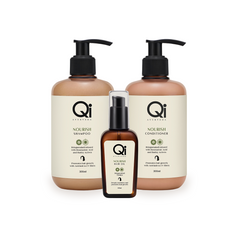
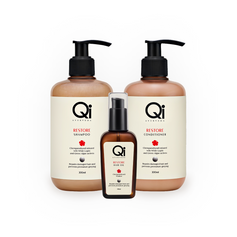
We use Bhringraj and Amla at the heart of our Nourish range, supporting hair growth and follicle health. Hibiscus leads our Restore collection, addressing breakage and signs of damage.
Each ingredient is selected with purpose and prepared with care. We work to preserve what traditional Ayurvedic practice understood intuitively: that the best haircare begins not with the strand, but with the scalp, and that nature, when handled with knowledge and respect, offers some of the most effective tools we have.
Explore the Qi Ayurveda range at qiayurveda.com