




For most hair types, shampoo and conditioner alone aren't enough to fully support
healthy-looking hair. Understanding the role of each step makes it easier to build a
routine that supports your hair's individual needs, rather than expecting one product
to do everything. Shampoo removes build-up from the scalp and hair, while
conditioner smooths and protects the outer layer of each strand.
Neither step is designed to provide ongoing nourishment to the hair fibre or leave-on care for the scalp, where a healthy scalp environment supports healthy-looking hair. This is why
traditional Ayurvedic hair rituals have long included oiling and scalp care alongside
cleansing. At Qi Ayurveda, we believe each step has a distinct purpose. Cleansing,
conditioning, nourishing the hair fibre, and supporting the scalp each require different
botanical ingredients, textures, and methods of application.
Rather than creating products that promise everything, we formulate each one to perform its purpose exceptionally well. Together, they become a ritual designed to support healthier-looking hair over time.
Why Aren't Shampoo and Conditioner the Whole Story?
Clean hair isn't always healthy hair.
A shampoo and conditioner routine can leave hair feeling fresh, soft, and
manageable, but these visible results only tell part of the story. Long-term hair health
depends not only on the condition of the hair you can see but also on the scalp
environment where every strand begins.
A strand may feel silky after conditioning yet remain vulnerable to dryness,
breakage, or environmental stress. Likewise, a clean scalp doesn't automatically
mean it is receiving the nourishment needed to support healthier-looking hair over
time.
Understanding the role of each step helps you build a routine based on what your
hair actually needs—and avoid expecting one product to solve concerns it was never
designed to address.
What Does Each Step in a Hair Care Routine Actually Do?
Every product in a complete hair care ritual serves a different purpose. Rather than
overlapping, these steps work together to support both the scalp and the hair fibre.
Shampoo Cleanses the Scalp and Hair
Shampoo is formulated to remove excess oil, dirt, sweat, pollution, and product
build-up using cleansing ingredients known as surfactants. This prepares the scalp
and hair for the next steps in your routine.
While cleansing is essential, shampoo is not intended to deeply nourish the hair or
remain on the scalp long enough to deliver ongoing care.
Conditioner Protects the Hair Surface
Conditioner focuses on the outermost layer of the hair, known as the cuticle. By
smoothing lifted cuticles, it improves softness, reduces friction, minimises frizz, and
makes hair easier to detangle.
Conditioner protects the surface of the hair, but it isn't intended to provide ongoing
scalp care or replace products designed to nourish the hair fibre.
Hair Oil Helps Nourish the Hair Fibre
Some botanical oils, depending on their fatty acid composition, can penetrate
beyond the hair surface, helping improve flexibility, reduce dryness, and reduce
protein loss, while others help protect the outer layer of the hair.
When massaged into the scalp, botanical oils also form part of a nourishing ritual
that has been central to Ayurvedic hair care for generations.
Scalp Treatments Support the Follicle Environment
Unlike rinse-off products, scalp treatments are designed to remain on the scalp. This
allows carefully selected botanical ingredients more time to support the scalp
environment surrounding the hair follicles.
Rather than replacing shampoo, scalp treatments extend care beyond wash day.
At a Glance: What Does Each Step Do?
| Hair care Step | Primary Purpose | What It Doesn't Do |
|---|---|---|
| Shampoo | Cleanses the scalp and hair | Doesn't deeply nourish the hair fibre or treat the scalp over time |
| Conditioner | Smooths and protects the hair surface | Doesn't replace hair oil or scalp treatments |
| Hair Oil | Nourishes the hair fibre and supports the scalp | Doesn't cleanse build-up |
| Scalp Treatment | Supports the scalp environment between washes | Doesn't replace shampoo |
Common Myth: "Conditioner Does the Same Job as Hair Oil"
Conditioner and hair oil are often used together because they work in different ways
rather than performing the same role.
Conditioner primarily smooths and protects the outer surface of the hair, helping
improve softness and manageability. Hair oil, on the other hand, is traditionally used
to nourish both the scalp and the hair fibre, supporting flexibility and helping reduce
dryness over time.
Using one doesn't eliminate the need for the other. Used together, they support
different layers of hair health.
Why Does a Multi-Step Routine Matter?
Different hair concerns begin in different places.
If you're experiencing increased shedding, supporting the scalp becomes especially
important because healthy hair grows from the follicle. If your concern is breakage,
dryness, or brittle lengths, the focus shifts towards protecting and nourishing the hair
fibre. For dandruff or an imbalanced scalp, targeted scalp care can complement
regular cleansing by helping maintain a healthier scalp environment.
A complete routine isn't about using more products. It's about giving each concern the care it actually requires.
The Ayurvedic Perspective
Ayurveda has long viewed hair care as a ritual rather than a single product.
Traditional practices recognised that cleansing, nourishment, and scalp care each
play a different role in maintaining healthy-looking hair. Botanical oils were often
massaged into the scalp before cleansing, while herbs were chosen to nourish both
the scalp and the hair according to individual needs.
Rather than asking one product to do everything, each step complemented the next,
creating a balanced routine that cared for both the scalp and the hair over time.
Where Swiss Botanical Science Fits
While Ayurveda offers centuries of botanical wisdom, modern Swiss formulation
expertise brings greater precision and consistency to botanical hair care.
Standardised botanical extracts help ensure ingredient quality, stability, and
consistency while allowing carefully researched plant actives to be incorporated
alongside traditional herbs. Rather than replacing Ayurvedic ingredients, this
approach enhances their application in contemporary hair care.
At Qi Ayurveda, this partnership between tradition and modern botanical science
shapes every formulation we create.
How to Build a Complete Hair Care Routine
Build your routine around purpose rather than the number of products you use.
Cleanse consistently, condition after every wash, nourish according to your hair's
needs, and support the scalp with leave-on care between washes. As your concerns
change—whether dryness, breakage, dandruff, or increased shedding—your ritual
can evolve with them. Above all, consistency matters far more than complexity
How Qi Ayurveda Approaches Healthy Hair
One of the principles we follow at Qi Ayurveda is that every step in a hair ritual
should have a clear purpose. Cleansing, conditioning, nourishing, and scalp care are
four distinct functions, so we formulate each product to perform one role
exceptionally well rather than expecting a single product to do everything.
Our sulphate-free shampoos are designed to cleanse gently while respecting the
scalp's natural balance. Our conditioners smooth the cuticle to improve softness and
manageability without weighing the hair down.
Our treatment products are formulated according to specific hair concerns rather
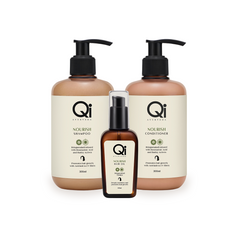
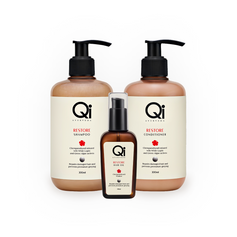
than a one-size-fits-all philosophy. The Nourish Range pairs Bhringraj and Amla with
Swiss botanical actives to support the scalp, Restore Range combines Hibiscus with
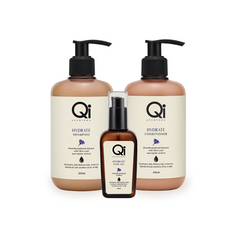
Swiss botanicals for dry or fragile strands, while Hydrate Range brings together
Indian Thornapple with certified Swiss actives to help maintain a balanced scalp
environment.
To complement these rituals, our Vitalise Daily Scalp Tonic extends care beyond
wash day by combining Rosemary and Triphala Hydrosol with Swiss Pea Sprout
Extract to support the scalp environment between washes.
Rather than expecting one product to do everything, we design each formulation to
contribute something meaningful to the overall ritual. This philosophy reflects our
belief that healthy-looking hair is built through purposeful care, thoughtful
formulation, and consistency over time.
Frequently Asked Questions
1. Is it necessary to use hair oil if I already use conditioner?
Yes. Conditioner smooths and protects the hair's surface, while hair oil helps nourish
the hair fibre and supports the scalp. Each serves a different purpose.
2. Can I use hair oil without conditioner?
Hair oil and conditioner complement one another rather than replace each other.
Conditioner improves manageability after washing, while hair oil supports
nourishment and helps protect the hair over time.
3. Do I need a scalp tonic if I already oil my hair?
Hair oil and scalp tonics have different functions. Hair oil forms part of a nourishing
ritual, while a leave-on scalp tonic is designed to remain on the scalp and provide
ongoing care between washes.
4. How many products do I really need in a hair care routine?
There's no universal number. The right routine depends on your hair concerns, but
most people benefit from addressing four key functions: cleansing, conditioning,
nourishment, and scalp care.
5. Will using more products make my hair feel heavy?
Not when each product has a clear purpose and is used appropriately.
6. How long does it take to notice results from a complete routine?
Hair often feels softer and easier to manage after the first few washes, while
improvements related to scalp health and healthier-looking hair typically require
several weeks or months of consistent care.
7. Can one product replace my entire routine?
No single product is designed to cleanse, condition, nourish the hair fibre, and care
for the scalp equally well. Each step performs a different function within a balanced
routine.
Key Takeaways
- Shampoo cleanses, while conditioner smooths and protects the hair surface.
- Hair oil nourishes the hair fibre, and scalp treatments provide ongoing care for
the scalp between washes. - Different hair concerns require different solutions, which is why each step in a
routine has a distinct purpose. - Traditional Ayurvedic rituals have long recognised the value of combining
cleansing, nourishment, and scalp care. - Healthy-looking hair is built through consistent, purposeful routines rather than
relying on a single product.
The most effective hair care routine isn't necessarily the longest—it's the one in
which every step has a clear purpose.
Conclusion
Shampoo and conditioner are essential foundations of a healthy hair care routine,
but they were never designed to do everything. Cleansing, conditioning, nourishing
the hair fibre, and caring for the scalp are distinct functions that work best when they
complement one another as part of a complete ritual.
At Qi Ayurveda, we believe healthy-looking hair is built through thoughtful rituals
rather than unnecessary complexity. By combining the wisdom of Ayurveda with the
precision of Swiss botanical science, we create purposeful formulations that work
together to care for the scalp, strengthen the hair fibre, and honour the quiet power
of consistent care.